

Scope creep isn’t a client problem. It’s mostly a pricing problem often found in your engagement letter.
I’ve coached hundreds of CPA firm owners, and I hear a similar story from them: a client keeps asking for “just one more thing.” Then the team does it, because that’s what good accountants do. By year end, an engagement that looked profitable on paper is underwater, and the owner is frustrated with a client who never did anything wrong. We can often trace it back to the creation of the engagement letter.
As firm owners, we often allow scope creep.
Most scope creep doesn’t come from a difficult client. It comes from a vague engagement letter. If the letter never said where the work stops, the client had no way of knowing they crossed a line. They didn’t creep, it turns out we just never drew the boundary. In fact, some firms don’t even have engagement letters, which makes it even harder to manage work and scope creep.
Billing vs. pricing: why hourly billing leads to scope creep
For years I’ve taught firm owners that billing and pricing are not the same thing. Billing happens after the work is done. It looks backward, measures time, and transfers the risk to the client. Pricing happens before the work starts. It looks forward, measures value, and shares the risk appropriately with the client (and I believe leads to stronger client relationships).
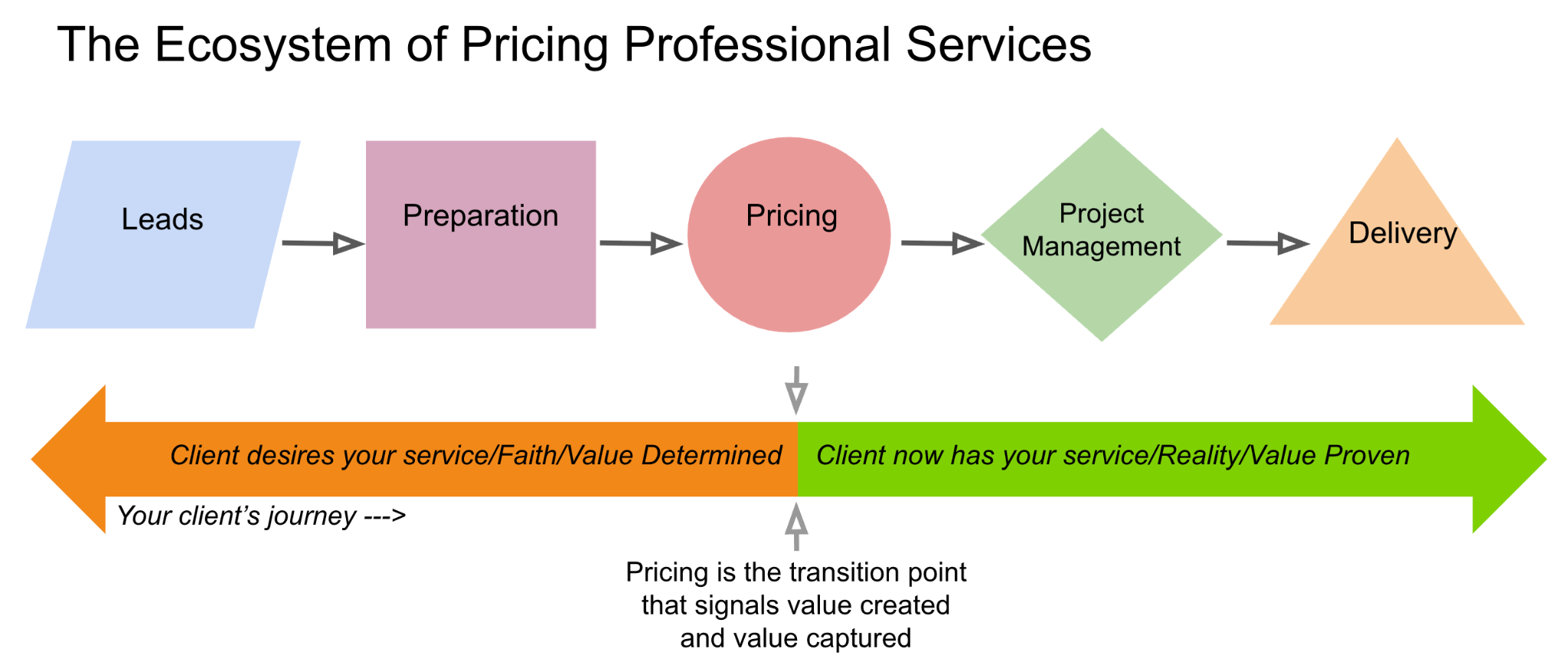
That’s why I push firms away from hourly billing, even though the switch from hourly to fixed pricing or value pricing is a difficult move for a firm to make. And to be sure, dropping the hourly rate isn’t the same as learning to price. Plenty of firms switched to fixed fees and kept the billing mindset. I teach this with a model I call the Ecosystem of Pricing Professional Services. A client moves through five stages: Leads, Preparation, Pricing, Project Management, and Delivery. Pricing sits in the middle. It’s the transition point where the value you’ve created becomes value you’ve captured. Before it, the client is buying on faith. After it, the value has to be proven in the work. The model looks like this:
What happens when you bill instead of price
Now compare that to the Ecosystem of Billing. It’s just Leads, Billing, and Delivery. Two stages are missing, and they’re the two that protect you. With no Preparation, the client believes they lead the relationship, and you can’t price for the value you see coming. And with no Project Management, the client ends up managing their own deliverables. Here’s what it looks like:
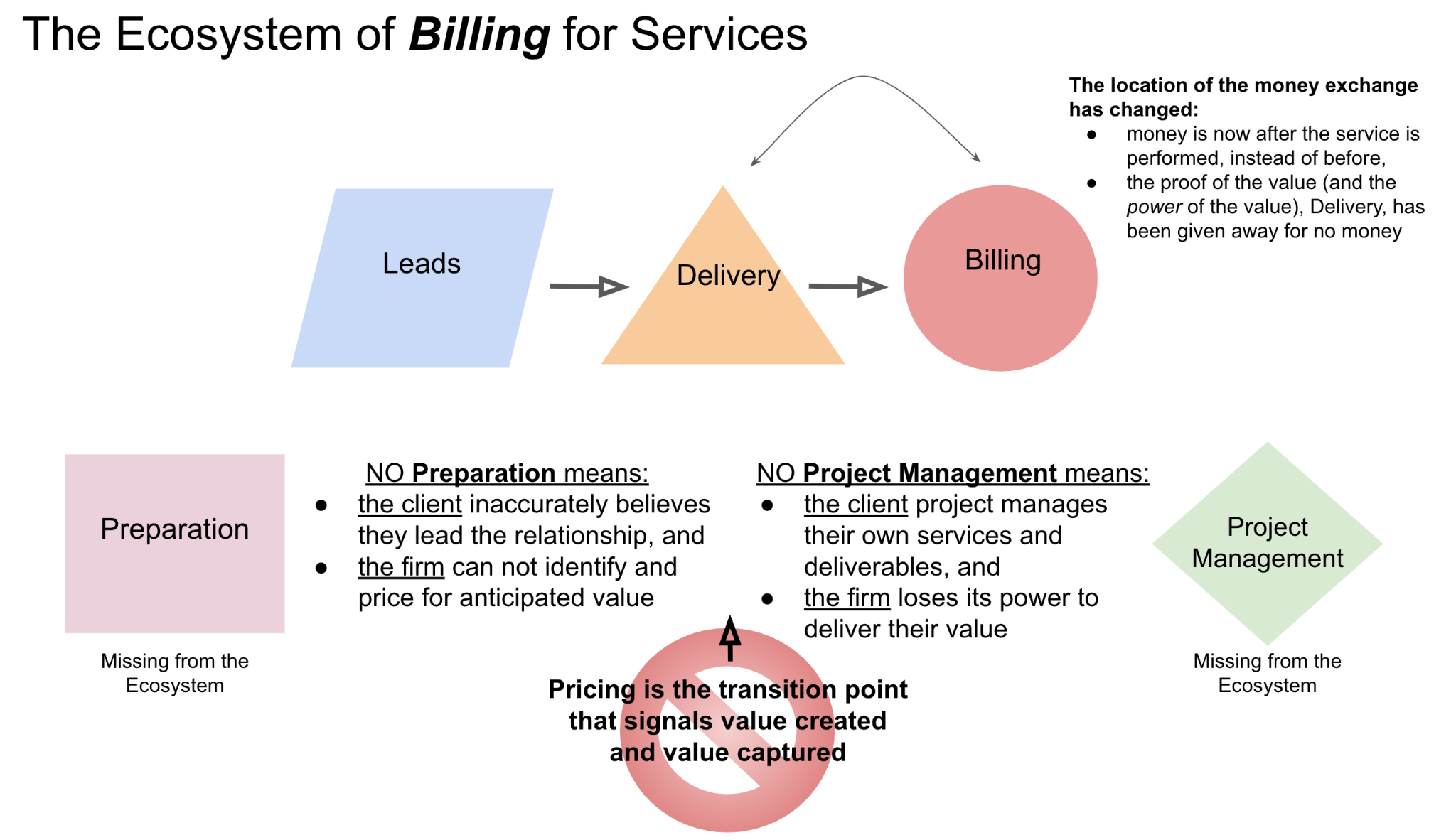
Now because the money shows up after the work, the proof of your value has already been given away for no money. Scope and delegation are where this costs real money. If you don’t sell the right amount of your team’s capacity for the right price, you end up delivering more value than you scoped, and your team gets overwhelmed. On the flipside, if you don’t lead your team to deliver exactly what was scoped, out-of-scope work eats your profit. Then you’ll keep hiring as you grow and watch your margins dwindle. Your team can’t protect a boundary they can’t see.
Why your engagement letter should renew every 12 months
Clients grow and their needs change, so the price can’t stay frozen. In my firm, we kept every client on a renewing agreement of 12 months or less. That rhythm forced a real review of scope and price every year, instead of letting both remain evergreen. The engagement letter is where all of this gets locked in. It’s the one document that holds your price, your scope, your team’s guardrails, and your renewal date in the same place.
What an accounting engagement letter should cover
In my pricing courses, I call this step Scoping: taking the agreed-upon pricing pitch and documenting it in a written contract so the work can be managed. Two of my ten tenets of value pricing go together:
- scoping with a contract is saying what you’ll do, and
- project management is doing what you said you would do
The best bookkeeping and accountant engagement letters aren’t long. They’re just specific. Whether you’re writing an engagement letter for accounting services, monthly bookkeeping, or an advisory relationship, it needs to answer four questions clearly.
What exactly are we doing?
Name the deliverables and the rhythm. “Bookkeeping services” isn’t scope. “Monthly reconciliations and financial statements delivered by the 15th, plus one quarterly advisory meeting” is clearer.
What are we not doing?
Spell out what’s out of scope, such as prior-year cleanup, new state registrations, or responding to tax notices. Naming it up front turns an awkward conversation later into a simple reference back to the agreement. Delivery should be an exact match to scope: no less, because under-serving erodes trust, and no more, because going above and beyond for free is foolish. We can’t always make our delivery match our scoped engagement letter perfectly, but we should strive for this.
How does extra work get requested and priced?
Clients will need extra work. Give them a clear path: they ask, you send a quote, they approve it before any work starts. Extra work gets priced before it’s done, never billed after the fact.
When do we revisit scope and price?
Put the review date right in the letter. Every 12 months is a good rhythm. When the client knows a review is coming, a price change is expected.
Run a 90-day scope check with new clients
Between renewals, I teach firms to run what I call a Feedback Loop about three months into every new client relationship. Perceived scope and delivered scope are two different things. Sit down with the client and ask three questions during this 90 day feedback loop meeting:
- What did you expect?
- What actually happened?
- What can we do now to add more value?
If the answers show the work has outgrown the price, adjust the services or reprice the contract. Don’t wait a full year to find out, do it after the first 90 days. A clear engagement letter also gives your team a document to point to when a client asks for something new.
How to send your engagement letter and Xero quote together
Engagement letter software for accountants can handle all of this in one step. If your firm runs on Xero, SignWell’s Xero integration lets you tie the price and the scope together in a single signed document.
You build the quote in Xero like you normally would and mark it as sent. Then you select that quote in SignWell and send it for signature, with your engagement letter attached in the same package. The client reviews and signs both at once, on any device, without creating an account. Once they sign, SignWell marks the quote as accepted in Xero and attaches the signed document to it. If you’ve turned on quote conversion, it also creates a draft invoice, ready for your team to review and send. Nobody re-keys anything, and the agreement lives right where your team already works.
I walked through the full workflow in an earlier post, so I won’t repeat it here. If you want the step-by-step, read How the SignWell and Xero Integration Saves Accounting Firms.
Draw the line before the work starts
Scope creep ends the day you decide where your work ends and put it in writing. Most clients want clear boundaries as much as you do. So pull out your current engagement letter and test it against those four questions. Then make sure the next client signs the price and the scope together. That’s the difference between billing for work you’ve already given away and pricing the value you’re about to deliver.
And if you need coaching around how to do this, reach out to us at Thriveal. We coach firms to build their firms more strategically and profitably: [email protected]